Industrial · Digital · Concept Study
LIGHT BOX
A smart lunchbox kit that tracks what you actually eat. Hardware + app, designed to make nutrition tracking effortless.
Revisited five years later through the lens of AI.
THE PROBLEM
Diet monitoring is broken.
In 2020, tracking what you ate meant typing every ingredient into a search box, guessing portion sizes, and hoping you remembered breakfast. Most people quit within a week.
Source: IFIC Foundation, 2019 Food and Health Survey
One in five global deaths is linked to poor nutrition.
More than high blood pressure. More than smoking. In 2020, this was the wake-up call that made me believe a better food tracker wasn't a vanity product - it was a public health tool.
Source: The Lancet, Global Burden of Disease Study (2019), University of Washington
THE SOLUTION
A smart lunchbox kit that does the work for you.
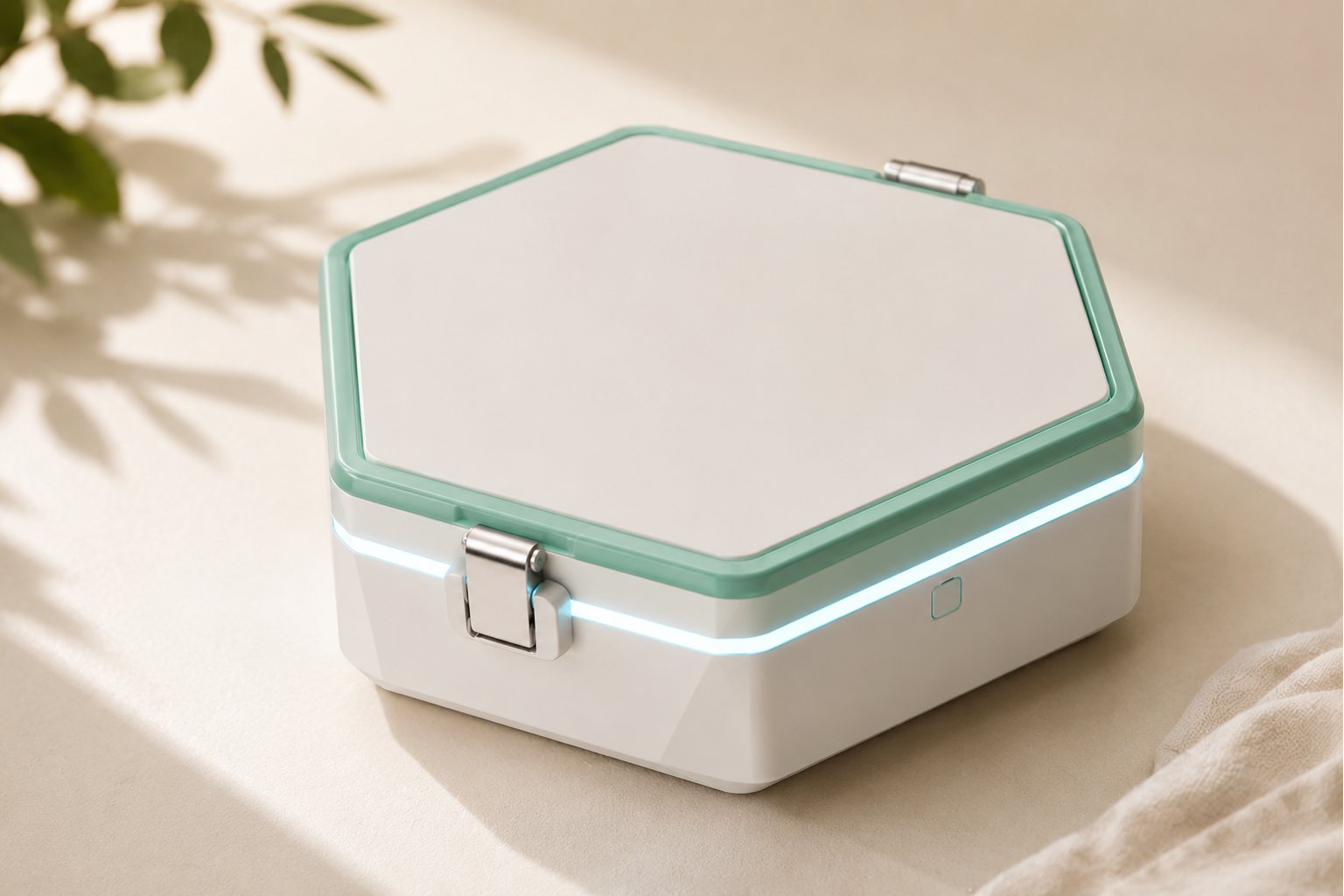
LIGHT BOX is a hexagonal lunchbox with built-in load cells and sensors, paired with a companion app. Drop your food in, and it weighs each portion and identifies it - no typing required.
Weigh, don't guess
Load cells in each compartment measure portions to the gram. The single biggest source of error in nutrition apps - portion estimation - is solved by hardware.
Identify, don't type
RFID tags on prepared foods, barcode scanning for packaged items, and image recognition for everything else. The app fills itself in.
Coach, don't dashboard
The companion app learns from your goals - lose weight, build muscle, maintain, eat healthier - and tells you what to eat next, not just what you ate yesterday.
01 - THE BOX
Industrial design with sensors built in.
A hexagonal form with three compartments, designed in SolidWorks. Each compartment holds a different food category - protein, carbs, vegetables - and weighs them independently.
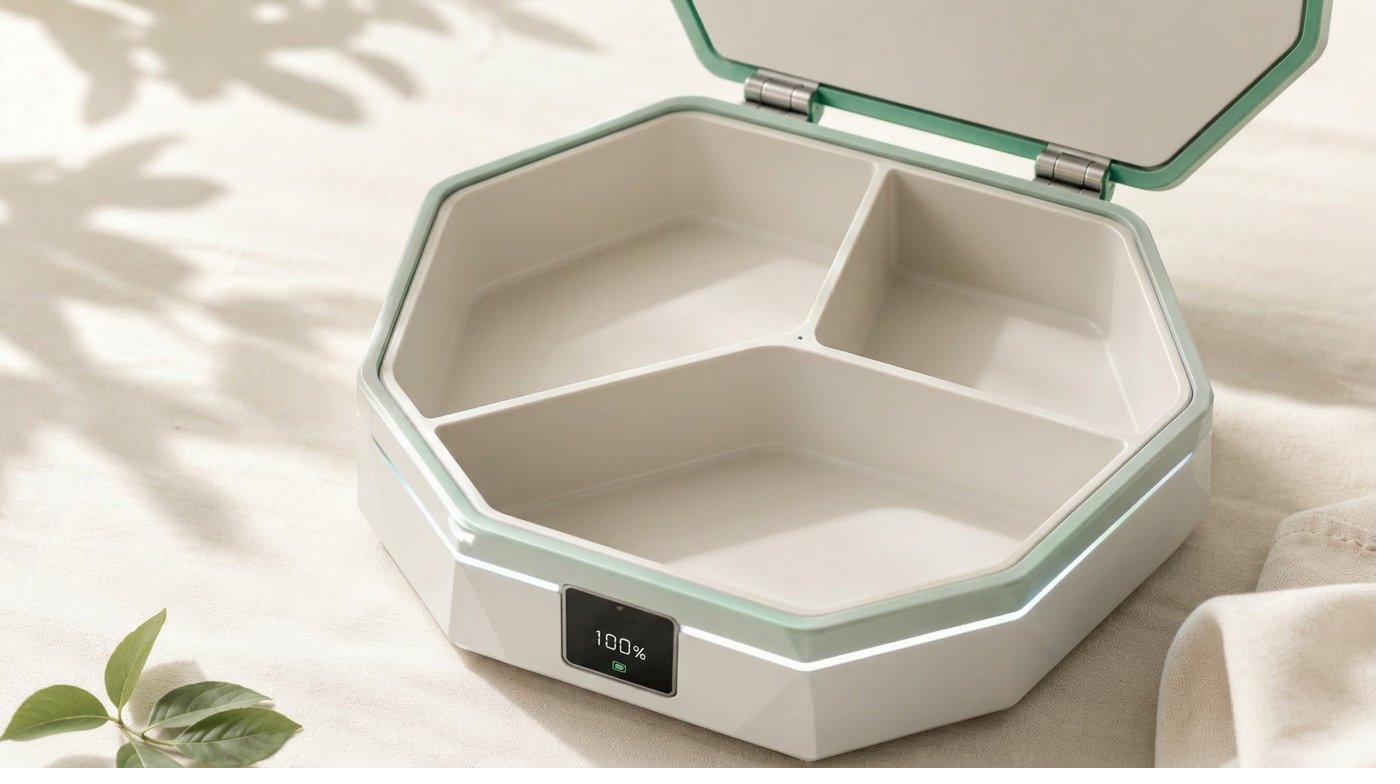
The empty box reveals the design intent - three compartments shaped to enforce balance, before food enters the equation.
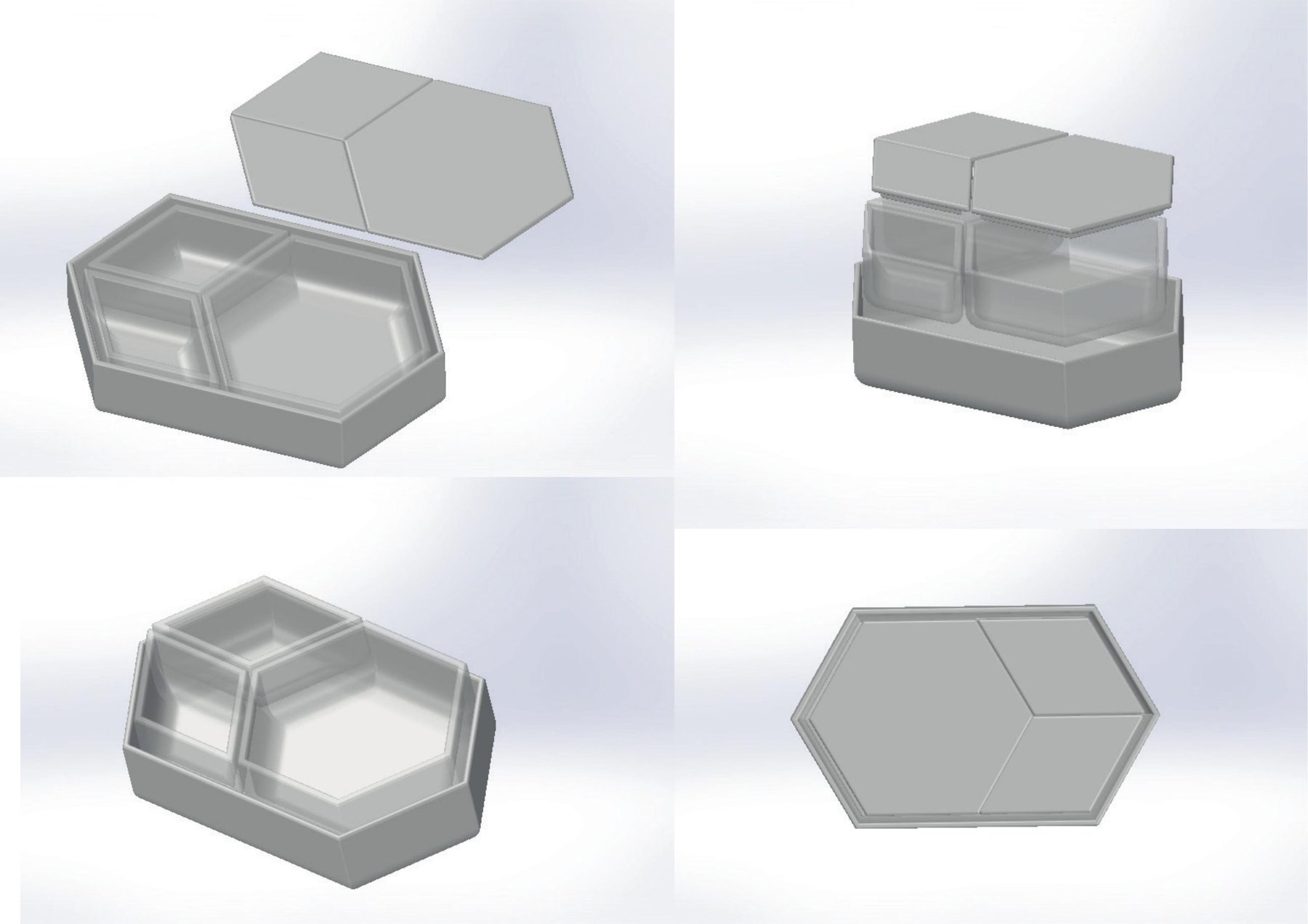
From SolidWorks to render
The 2020 CAD work, alongside a 2026 visualization of the same form factor.
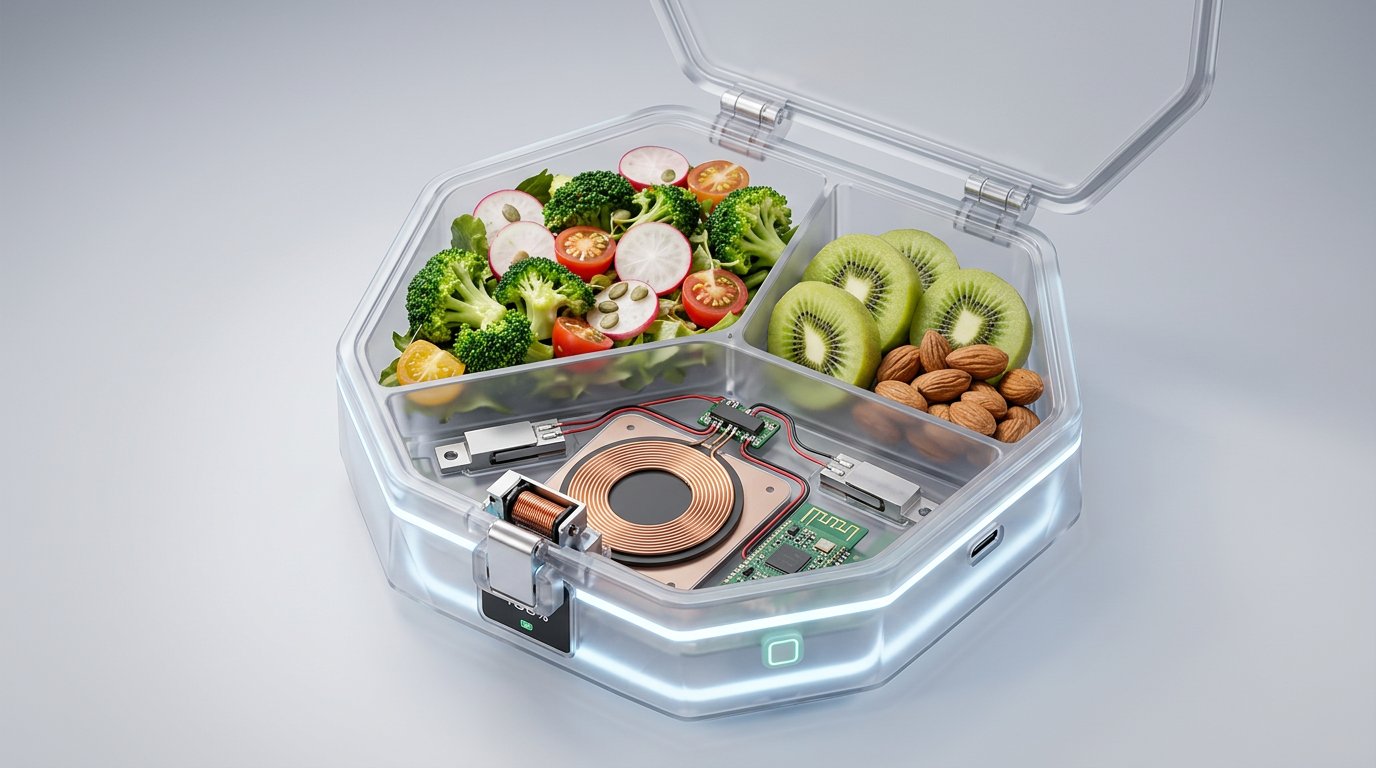
Six integrated sensors
Each component is purposeful. Together they replace the manual logging that kills nutrition apps within a week.
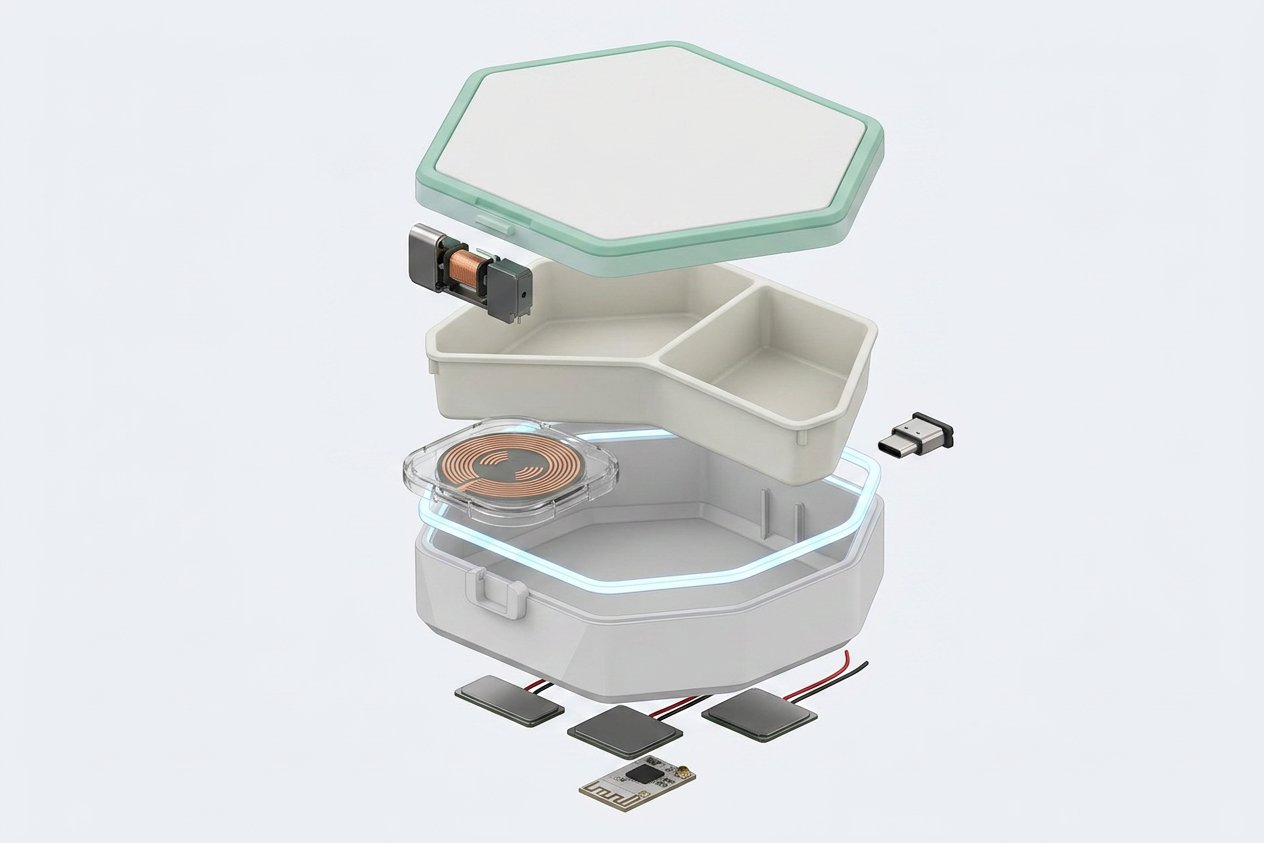
Each component breaks down to its purpose - RFID for instant food ID, load cells for weight-to-the-gram accuracy, WiFi for sync, electromagnetic lock for portion discipline.
WIFI
Syncs meal data to the cloud and the companion app in real time.
RFID Reader
Identifies pre-packaged foods by scanning their RFID tag for instant ID.
Load Cell
Weighs each compartment to the gram - the foundation of accurate portion tracking.
Electromagnetic Lock
Keeps the box closed until app-controlled meal times - useful for portion discipline.
LED Button
Single tap to confirm a meal - visual feedback that data has been captured.
USB
Charges the box and provides a wired backup for data transfer.
Hardware in context
A semi-transparent view showing how the sensors sit inside the form factor - invisible during use, working continuously underneath.
Form factor in use
Designed to stack for storage and travel, sized to be held comfortably in one hand.
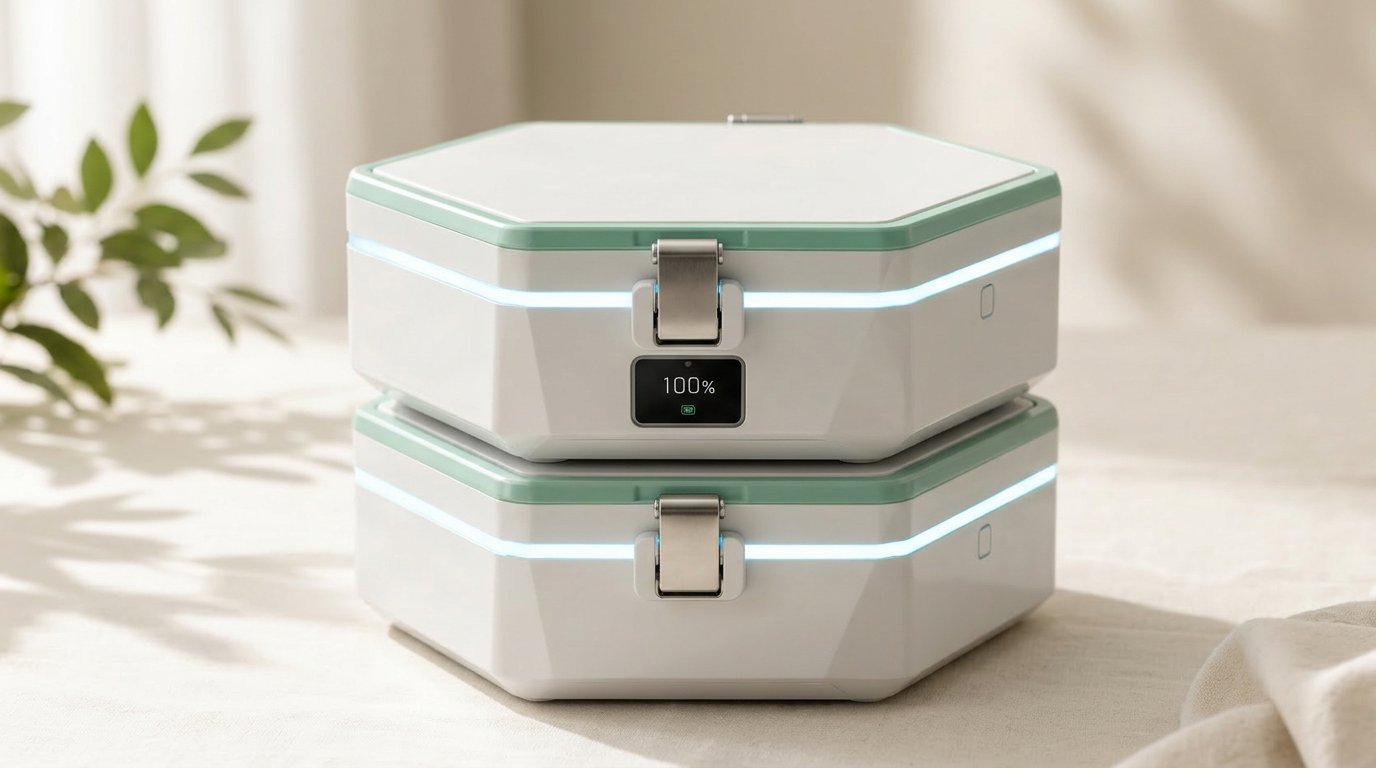
Stackable for storage and travel.
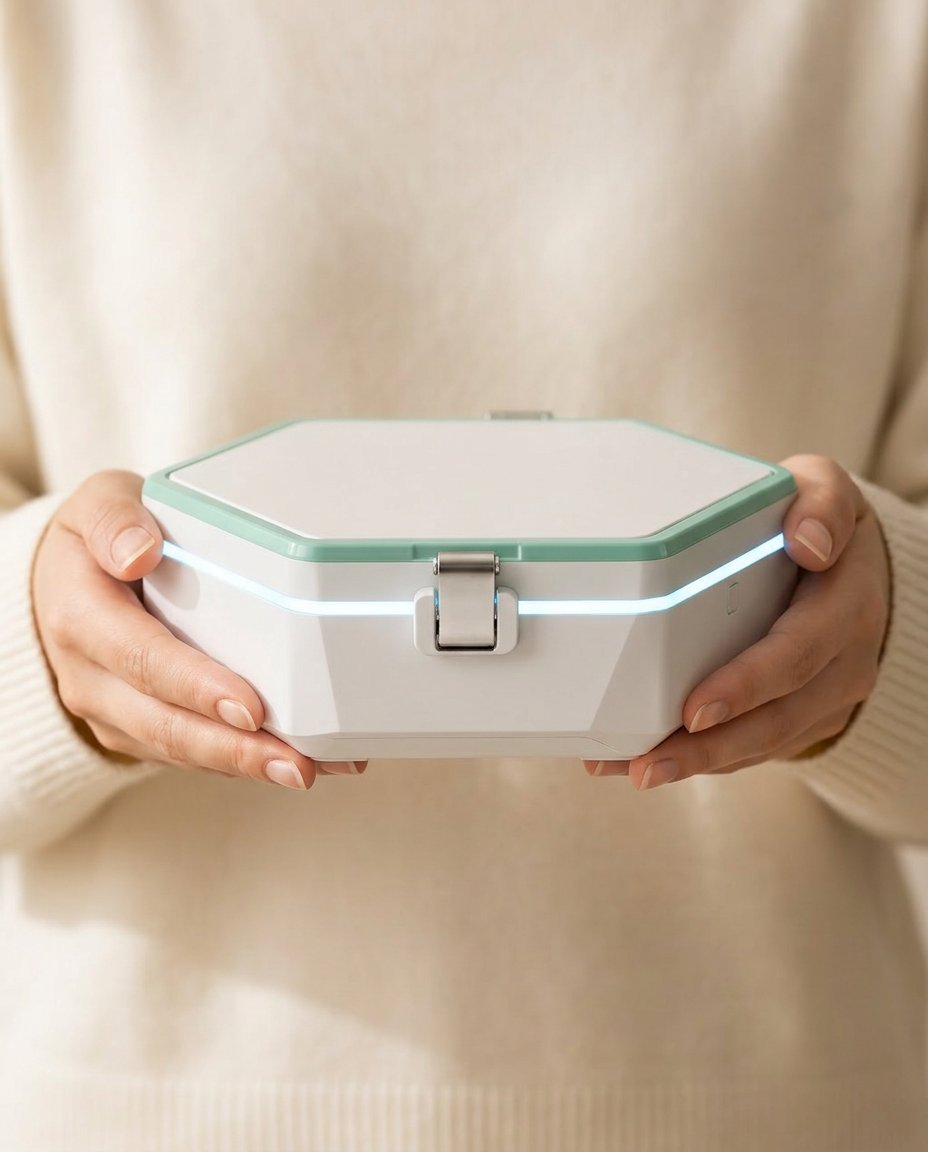
Sized for one-handed carry.
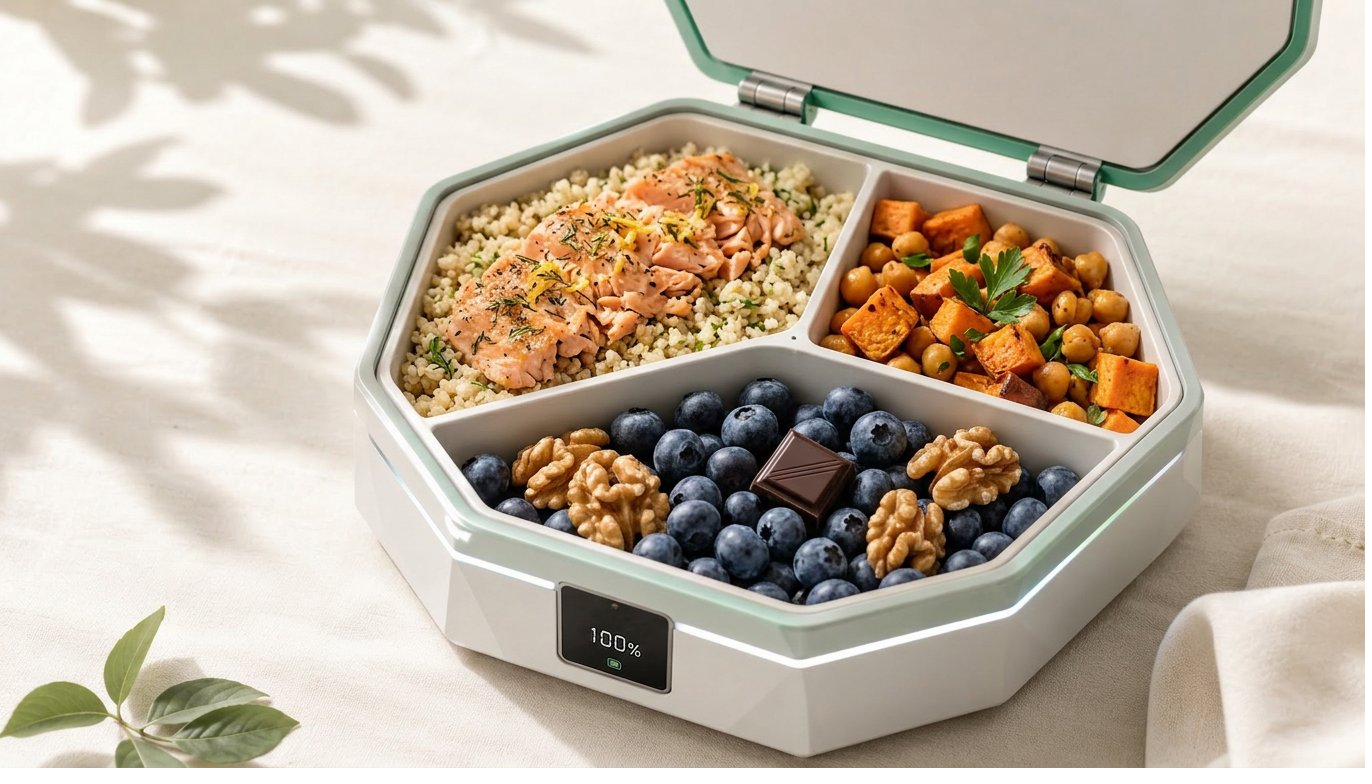
The three-compartment geometry isn't just visual - it gently enforces the protein / carb / vegetable balance that nutrition apps ask users to track manually.
02 - THE APP
A companion that learns your goals.
The app starts with a single question - what is your goal? - and adapts everything from there. Lose weight, build muscle, maintain, or eat healthier. Five core features, no clutter.
STEP 1 OF 3
What is your goal?
Easy-to-use food diary
Meals appear automatically from the box. No typing required.
Effective calorie counter
Calculated from real weights from the load cell, not user estimates.
Image recognition of food
For foods that aren't in the box - point your phone camera at the plate.
Barcode scanning
For packaged foods at the grocery store - log before you even open the box.
Weight tracking tool
Body weight trends shown alongside nutrition data over time.
The daily flow
From morning check-in to evening summary. Designed to be opened once per meal, no more.
CALORIES REMAINING
TODAY · DIARY
Boiled egg · Cream cheese · Bread
Rice · Chicken · Fresh veg
CHOOSE A CATEGORY
03 - VISUAL LANGUAGE
A design system rooted in clarity.
LIGHT BOX needed to feel calm, not clinical. Coral carries the energy and nutrition signal, mint green anchors the physical product, charcoal handles the data, and warm cream replaces the cold white of typical health apps.
00 - Logo Mark
A wordmark that breathes.
The original 2020 LIGHT BOX wordmark - LIGHT set in a thin geometric sans, BOX in a heavy condensed cut. The contrast between weight and air mirrors the product itself: a smart system, designed to feel calm.
Original wordmark, 2020 brochure system
01 - Color
Coral for energy. Mint for the product.
A four-color system. Coral signals every active state in the app - goal selected, meal logged, target hit. Mint stays anchored to the physical product (lid trim, LED accents). Charcoal handles numbers and headers where precision matters.
02 - Typography
A light geometric sans, set with intent.
The original 2020 brochure used a thin geometric sans-serif (Avenir / Futura family). Numbers stay large, body copy stays light. Weight carries the hierarchy, not size alone.
03 - Signature Tone
Coral as the energy signal.
Across every screen, coral marks the moments that matter: a goal selected, a meal logged, calories remaining. It's the brand's quiet promise of progress and energy.
04 - MARKET LANDSCAPE
An open quadrant in 2020.
Mapping the field on two axes: IoT capability vs ease of use. The top-right quadrant - genuinely smart hardware that anyone could pick up - was empty.
The competitive set
- Ovie - IoT food storage, but complex to set up
- Mealhero - smart, but not particularly user-friendly
- Silbo - easier to use, but limited IoT
- Under Armour - app-based, no hardware
- MyFitnessPal - manual entry, high friction
LIGHT BOX targeted the top-right quadrant: a true IoT product that anyone could use without reading a manual.
05 - BUSINESS MODEL
Three revenue layers, one ecosystem.
A Venn of three intersecting models: Trade (e-commerce), Product (software content), and Service (platform & agency). Where they overlap, four revenue mechanics emerge.
Marketplace
Trade × Product
A product and service marketplace - nutritionists, meal plans, food brands - selling through the LIGHT BOX app.
Ecosystem
All three
A technology and media platform that connects hardware, software, content creators, and food brands. The long-term play.
Brokerage
Trade × Service
An ad network and dropship program. LIGHT BOX brokers between food brands and consumers who match their target.
Subscription
Product × Service
Content as a service - premium meal plans, personalized coaching - and software as a service for power users.
06 - FIVE YEARS LATER
The problem didn't shrink. It grew.
When I designed LIGHT BOX in 2020, the global wellness economy was $4.2 trillion. Today it's $6.8 trillion - a 62% jump in five years. The need is sharper, the market matured, and one thing genuinely changed the game: AI.
THE WELLNESS ECONOMY
Global wellness economy in 2024 - up 62% from $4.2T in 2017, when I started this project.
Global Wellness Institute, Wellness Economy Monitor 2025
Projected to reach by 2029, at 7.6% annual growth.
Global Wellness Institute, 2025 Monitor
THE UNDERLYING PROBLEM
Of all global deaths in 2023 were associated with poor diet. Down from 20% in 2017 - improving, but still a leading risk factor.
Institute for Health Metrics and Evaluation (IHME), Global Burden of Disease Study 2023
Of cardiovascular disease deaths are attributed to poor diet. CVD remains the leading cause of death globally.
IHME, Global Burden of Disease Study (2021 data)
THE MARKET MATURED
Diet & nutrition apps market, 2024 to 2035. A 16.6% annual growth rate.
Roots Analysis Industry Report, 2025
MyFitnessPal users globally - the category leader, validating the market LIGHT BOX was designed for.
Data Bridge Market Research, 2024
THE SCALE COMPARISON
Wellness is now 4x larger than the global pharmaceutical industry ($1.8T) - and 60% the size of all global health expenditures.
Global Wellness Institute, 2025
Of global GDP is now in wellness, up from 5.7% in 2019 - a category that keeps gaining share.
Global Wellness Institute, 2025
THE AI INFLECTION POINT
Accuracy of MyFitnessPal's AI food recognition in a 2024 University of Sydney peer-reviewed study - identifying foods from photos with near-human precision.
But: the same study found that AI portion-size and calorie estimation remain inaccurate. This is precisely the gap LIGHT BOX's hardware was designed to solve.
Li et al., "Evaluating Manual Food Logging and AI-Enabled Food Image Recognition in Apps for Nutrition Care", Nutrients, August 2024 (DOI: 10.3390/nu16152573)
07 - LIGHT BOX 2.0
What I'd build today.
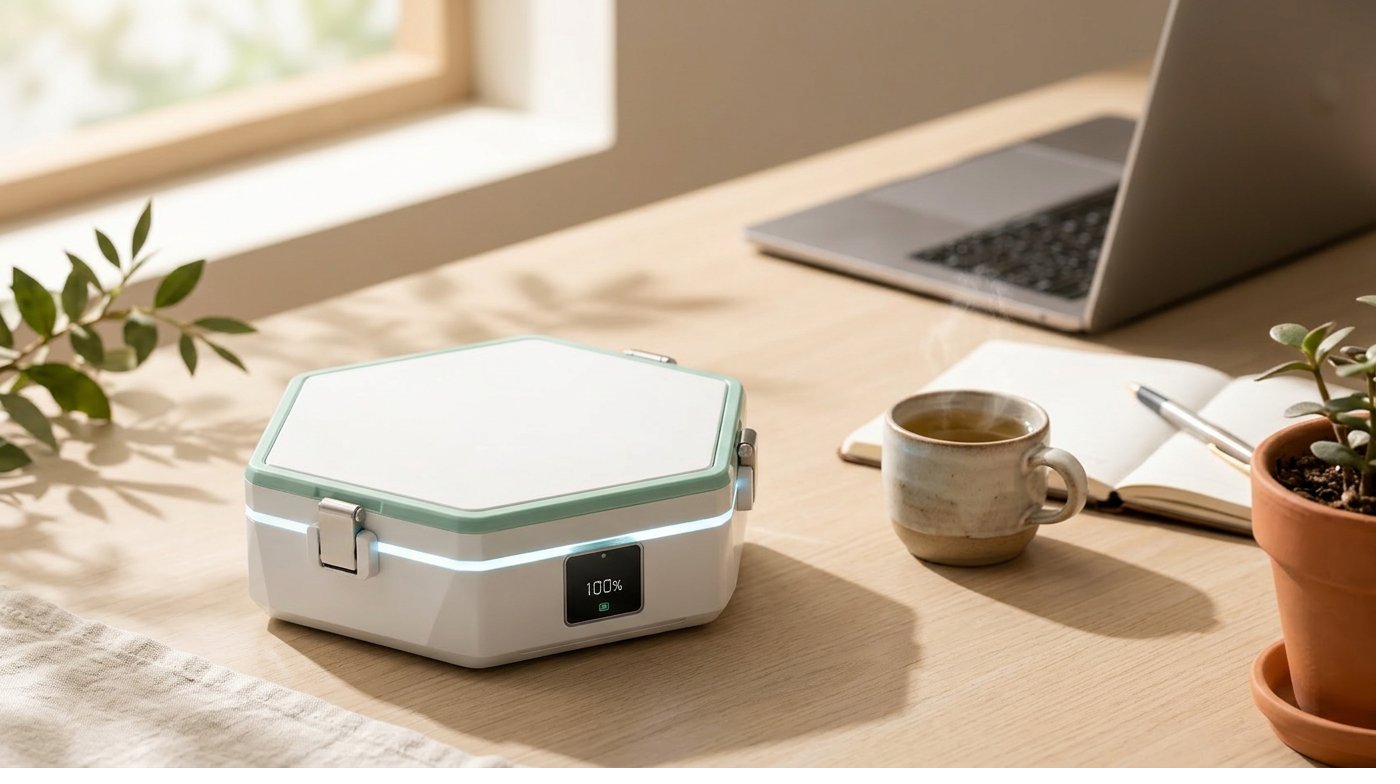
The 2020 version needed sensors because AI couldn't identify food. The 2026 version meets in the middle: a leaner hardware kit that hands off most of the recognition to AI, while keeping the one thing AI still gets wrong - portion size - in physical sensors.
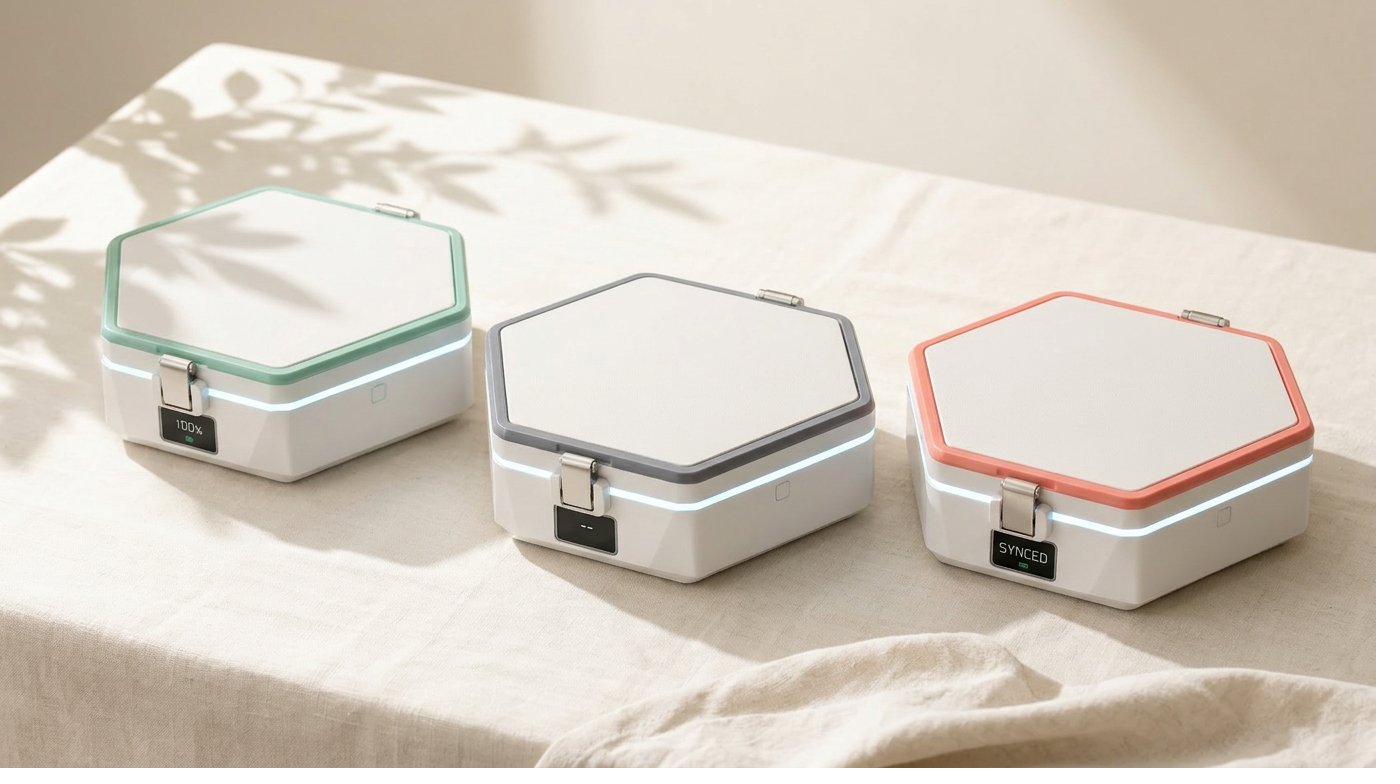
2026 imagines LIGHT BOX as a product family - three trim colors (mint, charcoal, coral) for different users, same internals.
Vision LLM for food identification
Replace the RFID reader with a phone camera and a vision model (Claude, Gemini, GPT-4V). The user opens the app, points at the box, and the food is identified in two seconds - no manual entry, no tag.
Conversational meal logging
"I had a chicken salad for lunch with about 150 grams of grilled chicken." Claude parses the sentence, extracts the ingredients, the portions, and the implied context. Forms are obsolete.
Hardware-validated portions
The load cell stays - it's still the most accurate way to weigh food. AI handles identification, hardware handles measurement. Each does what it's best at.
A nutrition coach with memory
An AI coach trained on the user's eating patterns over months. Notices that energy crashes correlate with low-protein lunches. Suggests adjustments before the user asks.
Predictive insights, not retrospective dashboards
"You're 200g of protein short for the week - here are three meals that would close the gap." The app tells the user what to do next, not what they already did.
DESIGN PHILOSOPHY
Look forward, not back.
Most nutrition apps drown users in what they already did - calories logged yesterday, days missed last week, charts of past failure. LIGHT BOX 2026 inverts that. The interface stays light, focused on the next decision, and celebrates progress instead of cataloguing slips.
RETROSPECTIVE
"You ate 1,247 calories yesterday. You went over your goal 3 days this week."
FORWARD-LOOKING
"You're 25g short on protein today. A 4oz chicken breast at dinner would close the gap."
Next action over past data
Every screen ends with what to do now, not what was missed.
Celebrate wins, surface streaks
A 12-day logging streak gets a moment. A missed day doesn't get a guilt screen.
Calm, not crowded
One key number per screen. Everything else earns its place by serving the next decision.
REFLECTION
Five years is a long time in product design.
Looking back at LIGHT BOX, the hardest part wasn't the industrial design or the app flow - it was the assumption that users would manually log every meal. We tried to solve it with sensors. AI solved it differently: by removing the manual step entirely.
What stays true is the core insight: portion size is what gets logged wrong, and that's still a hardware problem. The 2020 instinct was right. The 2026 execution would just be cleaner.
And one more lesson - the best nutrition tool doesn't show you what you ate. It shows you what to do next.